VA Loan vs Conventional Loan: Which Is Better in 2025?
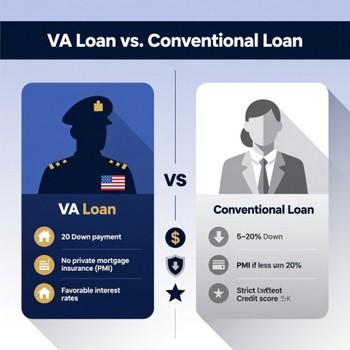 Choosing between a VA loan vs conventional loan is one of the most important financial decisions for veterans, active-duty service members, and eligible surviving spouses. Both can get you into a home, but they work in very different ways and carry very different costs. The Department of Veterans Affairs backs VA home loans, while no government agency backs conventional financing. Understanding the differences can save you thousands over the life of your loan.
This guide compares VA loans and conventional mortgages side by side on down payment, mortgage insurance, funding fees, credit standards, interest rates, and property rules. Whether you're buying your first home or weighing a refinance, this breakdown will help you identify which loan type fits your financial goals.
Written by W.A. MacDonald, retired loan officer.
What Is a VA Loan?
A VA loan is a mortgage benefit for active-duty service members, veterans, and eligible surviving spouses. Private lenders — banks and mortgage companies — issue the loans. The Department of Veterans Affairs guarantees a portion of each loan, which protects the lender if the borrower defaults. That guarantee is why lenders can offer terms that would not otherwise be available to most borrowers.
To qualify, you must meet VA service requirements. Generally, this means 90 consecutive days of active duty during wartime, 181 days during peacetime, or six years in the National Guard or Reserves. Eligible surviving spouses of service members who died in the line of duty may also qualify.
VA loans remove many of the common barriers to homeownership. There is no required down payment, credit score minimums are flexible, and there is no private mortgage insurance. The trade-off is a one-time VA funding fee and a requirement that the home be your primary residence.
Key Benefits of a VA Loan
- No Down Payment: You can finance 100% of the purchase price. This is the biggest single advantage for buyers who have not built up large savings.
- No Private Mortgage Insurance (PMI): VA loans do not require PMI, saving you hundreds of dollars per month compared to a conventional loan with less than 20% down.
- Competitive Interest Rates: Government backing reduces lender risk, so VA loan rates are typically lower than conventional rates for borrowers with similar credit profiles.
- Flexible Credit Standards: The VA sets no minimum credit score. Most lenders prefer 620, but they have more room to work with borrowers who have past credit issues.
- Lower Closing Costs: The VA limits the fees lenders can charge. Sellers can also pay up to 4% of the purchase price in concessions toward your costs.
- Streamlined Refinance Available: Existing VA borrowers can use the VA IRRRL (Interest Rate Reduction Refinance Loan) to refinance with minimal paperwork and no appraisal in most cases.
What Is a Conventional Loan?
A conventional loan is a mortgage that is not insured or guaranteed by any federal agency. It is the most widely used financing option in the United States. Most conventional mortgages follow guidelines set by Fannie Mae and Freddie Mac, which are government-sponsored enterprises. Loans within their published limits are called conforming loans.
Because the government does not back them, lenders take on more risk. To offset that risk, conventional loans require stronger borrower qualifications: higher credit scores, documented income, and typically a down payment. However, they offer flexibility that VA loans do not. You can use conventional financing to buy a primary residence, a second home, or an investment property.
Key Features of a Conventional Loan
- Low Down Payment Options: First-time buyers can put as little as 3% down through programs like Conventional 97, HomeReady, and Home Possible. Repeat buyers typically need 5%.
- PMI Required Under 20% Down: If your down payment is below 20%, you pay PMI each month. The key advantage: PMI is cancelable once you reach 20% equity, unlike FHA mortgage insurance which often lasts the life of the loan.
- Flexible Property Types: Conventional loans work for primary residences, vacation homes, and investment properties. VA loans do not allow any of these.
- High Loan Limits: The 2025 conforming limit is $806,500 for most areas, with higher limits in high-cost counties. Above that, jumbo financing is available.
- No Funding Fee: Conventional loans charge no government fee comparable to the VA funding fee, though you will pay standard closing costs.
VA Loan vs. Conventional Loan: Side-by-Side Comparison
The table below covers the core differences between these two mortgage types. Use it to identify which program fits your situation before speaking with a lender.
| Feature | VA Loan | Conventional Loan |
|---|---|---|
| Down Payment | $0 required. You can finance 100% of the purchase price. | 3% to 20%. At least 3% for first-time buyers; 20% to avoid PMI. |
| Mortgage Insurance | None. No monthly insurance premium of any kind. | PMI required if down payment is below 20%. Cancelable at 20% equity. |
| Credit Score | No VA minimum. Most lenders prefer 620 but allow flexibility. | 620 minimum. Best rates require 740 or higher. |
| Interest Rates | Typically lower. Government backing allows competitive pricing. | Rates vary by credit. Borrowers with 740+ can approach VA-level rates. |
| Property Type | Primary residence only. No second homes or rental properties. | Any property type. Primary, vacation, and investment properties all qualify. |
| Funding Fee | VA funding fee required unless exempt. First-time use with zero down: 2.15%. Second use: 3.3%. Can be rolled into the loan. Disabled veterans are exempt. | No funding fee. Standard closing costs apply. |
| Loan Limits | No loan limit for borrowers with full entitlement. Borrow as much as you qualify for. | Conforming limit of $806,500 in most areas for 2025. Jumbo loans available above that. |
| Eligibility | Military service required. Active duty, veterans, National Guard, Reserves, and eligible surviving spouses. | Open to all borrowers who meet credit, income, and down payment requirements. |
Is a VA Loan Better Than a Conventional Loan?
For most eligible borrowers, the VA loan wins on pure cost, especially when buying with little or no down payment. The combination of zero down, no PMI, and below-market rates is difficult to beat. A veteran buying a $400,000 home with a VA loan avoids both a $20,000–$80,000 down payment and PMI that could run $150–$500 per month.
That said, conventional financing makes more sense in specific situations. If you have excellent credit and can put 20% down, you avoid PMI and pay no funding fee. Depending on how long you stay in the home, the total cost difference may narrow or flip. Conventional loans are also your only option if you are buying a vacation home or adding to a rental portfolio, since VA loans require owner-occupancy.
Use our Mortgage Comparison Calculator to run the numbers on both options with your actual loan amount, credit score, and down payment.
Cost Analysis: VA Funding Fee vs. PMI
The biggest structural cost difference between these two loans is how they charge for lender protection.
With a VA loan, you pay a VA funding fee — a one-time charge that helps offset the program's cost to taxpayers. For first-time users with zero down, the fee is 2.15% of the loan amount. For subsequent use with zero down, it rises to 3.3%. Put 5% or more down on a first-time use and the fee drops to 1.5%. You can roll this fee into the loan balance, so no out-of-pocket payment is required at closing. Veterans receiving VA disability compensation are exempt from the fee entirely.
With a conventional loan, if your down payment is below 20%, you pay PMI every month. Rates typically run 0.5% to 1.5% of the original loan amount annually. On a $350,000 loan, that is roughly $145 to $438 per month. You continue paying until you reach 20% equity and request removal. Over five years, that PMI cost alone can exceed what you would have paid in a VA funding fee.
For buyers who plan to stay in the home five years or longer with minimal down payment, the VA loan usually wins the cost comparison by a significant margin.
Credit and Qualification Standards
Conventional loans follow Fannie Mae and Freddie Mac guidelines closely. You generally need a credit score of at least 620. Your debt-to-income ratio (DTI) should be below 45%–50%. Stable employment and sufficient documented income are required. Borrowers with past bankruptcies or foreclosures typically face waiting periods of four to seven years.
VA loans offer more flexibility on all of these points. The VA sets no credit score floor, which gives lenders room to approve borrowers with past credit problems. Waiting periods after bankruptcy or foreclosure are shorter — often two years for a Chapter 7 bankruptcy. Rather than relying solely on DTI, VA underwriting also considers "residual income" — the cash left over after all major monthly obligations. This approach helps veterans with slightly higher DTI ratios still qualify when their overall financial picture is stable.
Property and Occupancy Rules
VA loans require that the home be your primary residence. You must move in within 60 days of closing in most cases, and you must intend to live there for most of the year. You can buy a multi-unit property of up to four units, but you must occupy one of them. You cannot use a VA loan to buy a rental property, a vacation cabin, or a second home.
Conventional mortgages allow all property types. You can finance a primary residence, a second home, or a pure investment property. This makes conventional financing the default choice for real estate investors and for veterans who have already used their VA benefit on a primary home and want to build a portfolio alongside it.
Frequently Asked Questions
What is the main difference between VA and conventional loans?
VA loans are backed by the Department of Veterans Affairs, which allows zero down payment and no PMI. Conventional loans are not government-backed, so they require a down payment and PMI if you put less than 20% down. Conventional loans also allow second homes and investment properties, while VA loans are restricted to primary residences.
Is the VA funding fee worth it compared to paying PMI?
For most buyers, yes. The VA funding fee is a one-time cost that can be rolled into the loan. PMI is a recurring monthly expense paid until you reach 20% equity. Over the first several years of a low-down-payment loan, the cumulative PMI cost typically exceeds the one-time funding fee, making the VA loan the more cost-effective option for buyers without a large down payment.
Can I use a VA loan to buy a second home or vacation home?
No. VA loans are limited to owner-occupied primary residences. If you want to buy a vacation home or a rental property, you will need conventional financing or another mortgage type.
Do I need a perfect credit score to get a VA loan?
No. The VA sets no minimum credit score. Most lenders look for 620, but they have more flexibility with VA loans than with conventional options. Stable income and VA eligibility can offset credit imperfections in ways that conventional underwriting typically does not allow.
What happens to my VA loan if I move?
You have options. Selling the home and paying off the loan restores your full VA entitlement. You can keep the home and rent it out, but this ties up part of your entitlement. You can also refinance the home into a conventional mortgage, which frees up your VA entitlement so you can use the benefit again on your next primary residence.
Which Loan Is Right for You?
If you are an eligible veteran or service member buying a primary residence with limited savings, the VA loan is one of the strongest mortgage benefits available. Zero down, no PMI, and competitive rates add up to substantial savings over a 30-year loan.
If you have strong credit, a 20% down payment, and are buying a second home or investment property, conventional financing is the practical choice. The flexibility in property types and the eventual cancellation of PMI are real advantages for the right borrower.
Compare both options directly with your numbers. Our Mortgage Comparison Calculator lets you enter your loan amount, interest rate, and down payment to see exactly which option costs less over time. Then speak with at least two lenders — one who does a high volume of VA loans and one who specializes in conventional — and compare their actual rate quotes before making a final decision.
Connect With Us
Please share – it really helps